

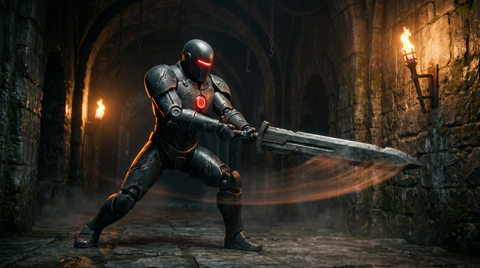
Massively multiplayer online role-playing games represent some of the most animation-intensive projects in game development. With thousands of players sharing a persistent world, the animation systems powering these experiences must be robust, scalable, and deeply varied. From the moment a player creates their character to their thousandth hour in-game, animations define how the world feels and how players express themselves within it.
This guide explores the key animation systems that make MMORPGs come alive, from social emotes to complex combat sequences, and explains how motion capture provides the foundation for authentic, high-quality character movement at scale.
Emote Systems and Social Animation Libraries
Emotes are the lifeblood of social interaction in MMORPGs. Players use them to greet each other, celebrate victories, express frustration, or simply have fun. A mature MMO might ship with 50 to 200 emote animations covering waves, bows, dances, laughs, cheers, taunts, and dozens of situational gestures.
Building an emote library requires careful attention to personality and timing. Each emote needs to loop cleanly or resolve gracefully back to idle, and the animations must read clearly even on small characters viewed from a distance. Motion capture is essential here because hand-animated emotes often feel stiff or exaggerated. Captured performances from real actors deliver the subtle weight shifts, natural timing, and authentic body language that players instinctively recognize.
Combat Animation for Multiple Classes
MMORPGs typically feature multiple character classes, each with distinct combat styles. A warrior class needs heavy, grounded attacks with visible follow-through and weapon weight. Mage archetypes require dramatic casting poses, channeling stances, and spell release animations. Rogue characters demand quick, agile strikes with evasive footwork and acrobatic dodges.
Each class may need 30 to 60 combat animations covering basic attacks, special abilities, critical hits, blocks, parries, and stagger reactions. Multiply that across six or more classes, and you quickly reach hundreds of required combat animations. Motion capture sessions organized by combat archetype allow studios to capture authentic martial arts, stage combat, and stylized movement from performers who specialize in each fighting style.
Weapon-Specific Animation Sets
Beyond class archetypes, weapon types add another layer of complexity. A character wielding a two-handed sword moves differently from one using dual daggers or a staff. Each weapon type needs its own locomotion set, idle poses, and attack chains, ensuring that the weapon's weight and reach are visually communicated through the character's body mechanics.
Mount Animation and Mounting Transitions
Mounts are a staple of MMORPGs, and the mounting and dismounting transitions are surprisingly important to player satisfaction. A clean mount animation shows the character reaching for the saddle, swinging a leg over, and settling into a riding position. The dismount mirrors this with appropriate momentum.
Riding animations must account for different mount types: horses require posting or seated gallop cycles, flying mounts need the rider leaning into turns, and exotic creatures like dragons or mechanical vehicles each demand unique rider postures. The rider's body must also react to changes in speed and direction, with subtle leans and weight shifts that sell the physics of movement.
Swimming and Underwater Locomotion
Water environments in MMORPGs present unique animation challenges. Surface swimming requires a treading-water idle, forward crawl or breaststroke locomotion, and transitions between surface and underwater states. Submerged movement needs its own set of animations with floatier timing and broader, slower movements that convey water resistance.
Combat while swimming adds further complexity, as attack animations must work within the constraints of underwater movement. Many MMOs simplify this by restricting combat abilities in water, but the locomotion itself still needs to feel natural and responsive.
Flying Mounts and Aerial Combat
Flying introduces a full three-dimensional movement space. Rider animations must communicate pitch, roll, and yaw through body posture. Ascending, the rider leans forward; descending, they lean back. Sharp turns produce visible lateral lean. Hovering requires a distinct idle animation different from ground-based standing.
Games that include aerial combat need attack animations that work while airborne, along with hit reactions and recovery poses that account for the lack of ground contact. These systems often blend procedural animation with authored clips to handle the full range of possible orientations.
Crafting and Gathering Animations
Life skills and crafting are core to many MMORPGs, and each profession benefits from dedicated animations. Mining swings a pickaxe with appropriate impact timing. Herbalism involves kneeling and carefully picking plants. Blacksmithing shows hammering at an anvil. Cooking stirs pots and chops ingredients.
These animations serve both gameplay feedback and world immersion. When players see others performing crafting animations in town squares, it creates a sense of a living, productive world. Motion captured crafting animations feel significantly more natural than hand-keyed alternatives, especially for repetitive actions where subtle variation prevents robotic-looking loops.
NPC Ambient Life Animations
A convincing MMO world needs NPCs that feel alive even when players are not interacting with them. Shopkeepers arranging wares, guards patrolling routes, villagers sweeping porches, children playing, and tavern patrons eating and drinking all contribute to world immersion.
These ambient animations are typically lower priority than player character animations but collectively have an enormous impact on world feel. A library of 20 to 40 ambient life animations can be mixed and matched across NPC archetypes to populate entire cities with believable background activity.
Group Interaction Animations
MMOs are inherently social, and group interaction animations reinforce this. Trading animations show characters exchanging items hand to hand. Synchronized dance emotes let groups perform choreographed routines. Handshakes, high-fives, toasts, and other paired animations require careful synchronization between two characters.
These paired animations need precise alignment and timing data so that two characters of potentially different sizes connect convincingly. The technical challenge of synchronizing animations across network latency makes clean, well-authored source animations even more critical.
Animation LOD for Massive Worlds
When hundreds or thousands of characters are visible simultaneously, performance optimization becomes essential. Animation level of detail (LOD) systems reduce the computational cost of distant characters by simplifying their animation playback.
Close characters play full-fidelity animations at high frame rates. Mid-distance characters might skip to half-rate updates. Far characters could use simplified two-bone approximations or even billboard sprites. The source animations must be authored with this degradation in mind, ensuring that key poses read clearly even at reduced fidelity.
Animation Networking and Synchronization
In a networked environment, animation state must be communicated efficiently between clients. Rather than streaming full animation data, MMOs typically send state identifiers and blend parameters. Each client then plays back the appropriate animation locally.
This means animations must be designed with network-friendly state machines in mind. Clean transitions, well-defined entry and exit points, and predictable timing all contribute to smooth networked playback. Animations that rely heavily on precise timing or continuous blending can be problematic in high-latency environments.
Character Customization Impact on Animation
MMORPGs allow extensive character customization, including body scaling that can range from short and stocky to tall and lean. Animations must accommodate this range without breaking contact points or creating visual artifacts. A swing that looks powerful on a large character should not make a small character's weapon clip through the ground.
Retargeting systems handle much of this automatically, but the source animations need clean, well-structured data to retarget successfully. Motion capture data with clear joint hierarchies and consistent proportions provides the best foundation for retargeting across varied body types.
How MoCap Packs Power MMO Animation
Building an MMORPG's animation library from scratch through custom capture sessions is enormously expensive. Pre-built motion capture packs offer a practical alternative, providing professionally captured emote libraries, combat sets, locomotion cycles, and interaction animations that can be retargeted to any character rig.
A single comprehensive MoCap pack can provide the idle, walk, run, and emote foundation that would otherwise require days of studio capture time. Studios can layer custom animations on top of this foundation, focusing their capture budget on unique signature moves while using pack animations for the hundreds of standard movements every MMO needs.
Frequently Asked Questions
How many animations does a typical MMORPG need?
A fully featured MMORPG typically requires 500 to 2,000+ unique animations when accounting for multiple classes, weapon types, emotes, locomotion sets, and NPC behaviors. Major titles like World of Warcraft or Final Fantasy XIV have accumulated thousands of animations over their lifespans through expansions and updates.
Can motion capture animations be used across different character races and body types?
Yes. Motion capture data can be retargeted to different skeletal proportions, allowing one captured performance to drive characters of varying heights, builds, and even non-human proportions. The key is having clean source data with well-defined joint hierarchies that retargeting systems can map accurately.
How do MMOs handle animation synchronization with server lag?
MMOs use predictive animation playback on the client side combined with server-authoritative state validation. Clients begin playing animations based on local input prediction, then correct if the server reports a different state. Well-designed animation state machines with smooth transitions help mask the corrections that network latency inevitably requires.
What frame rate should MMO animations be captured or authored at?
Motion capture is typically recorded at 60 or 120 fps, then exported at 30 fps for in-game use. The higher capture rate ensures smooth source data that can be downsampled cleanly. In-game playback rates may vary based on LOD distance, with close characters updating at 30 fps and distant characters at 15 fps or lower to conserve performance.
Looking for professional punch animations? Check out the Punch MoCap Animation Pack — production-ready motion capture data available in FBX, Unreal, Unity, Blender, BIP, and iClone formats.
MMORPG Animation Optimization for Large-Scale Encounters
Raid encounters with 20 to 40 players on screen simultaneously push animation systems to their limits. Each visible character evaluates a full animation state machine, processes blend trees, and updates bone transforms every frame. Without aggressive optimization, a single 24-player raid can consume more CPU time in animation evaluation than in rendering the entire game world.
Level-of-detail animation is the primary optimization strategy. Characters close to the camera run full animation evaluation with IK corrections, blend shapes for facial expressions, and secondary motion on capes and hair. Characters at medium distance skip facial animation and IK, running only the base locomotion and combat state machines. Distant characters beyond 30 meters switch to simplified two-bone approximations or pre-baked animation textures that bypass the skeletal animation pipeline entirely.
Animation instancing reduces memory and CPU cost when multiple characters play identical animations. In a town hub where 50 NPCs idle simultaneously, instanced animation evaluates the idle state machine once and copies the resulting bone transforms to all instanced characters with a per-instance time offset. This technique reduces animation CPU cost by 90% or more for background characters, freeing resources for the player's character and nearby party members.
Server-authoritative animation in MMORPGs differs fundamentally from single-player games. The server dictates which animation state each character should be in (idle, casting, attacking, stunned) while the client handles visual interpolation between states. This architecture prevents animation-based exploits like canceling attack recovery frames, but it introduces latency between player input and visual feedback. Modern MMOs use client-side prediction — the animation begins immediately on the client, and the server confirms or corrects within one to two network ticks.
Asynchronous animation loading prevents hitching during large encounters. When a new player enters visual range during a boss fight, their animation data loads on a background thread while a placeholder idle animation plays. Once the full animation set is available, the system crossfades from the placeholder to the correct combat animation over two to three frames. This approach eliminates the frame spikes that plagued older MMOs when many characters appeared simultaneously during world events.
Memory pooling for animation clips is essential at scale. Rather than loading animation data per character instance, MMOs maintain a shared animation library organized by character race and class. All human warriors reference the same attack animation clips, with per-character variation achieved through additive layers and IK adjustments. This shared-resource model keeps animation memory under 200 megabytes even in crowded city zones with hundreds of visible characters.
Player animation expectations in MMORPGs have increased dramatically since the genre's early days. Classic MMOs like EverQuest shipped with fewer than twenty animations per character race, while modern titles like Lost Ark and Final Fantasy XIV feature hundreds of unique animations per class including elaborate skill effects, mount animations, and social interactions. This animation inflation means new MMORPG projects must budget for significantly larger animation libraries than their predecessors. However, the combination of motion capture technology, runtime retargeting, and procedural animation techniques makes it possible to achieve modern quality standards without proportionally increasing production budgets. The key efficiency lever is identifying which animations require bespoke motion capture and which can be assembled from existing clip libraries with additive layers and IK modifications applied at runtime to create the appearance of unique character-specific motion.